
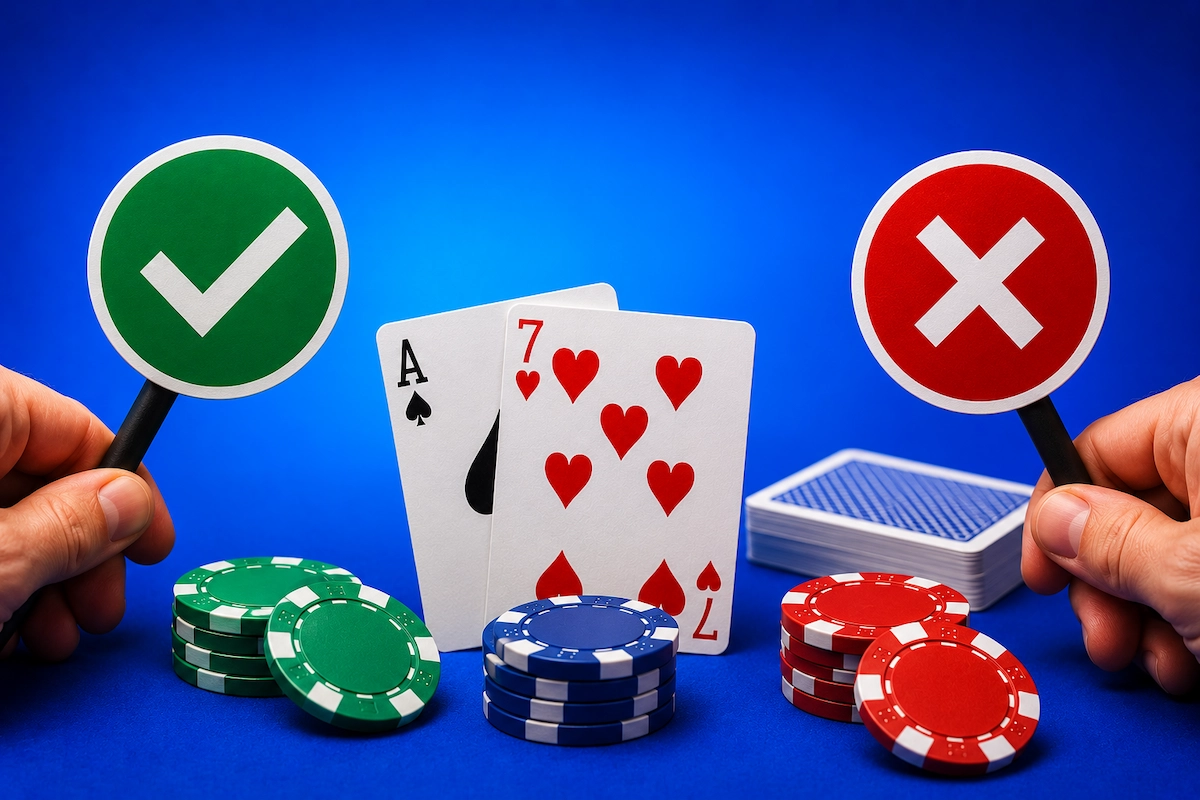
Blackjack looks simple on the surface.
Get close to 21 without going over.
But once you actually sit at the table, one question causes more confusion than almost anything else:
“Should I hit or stand here?”
A lot of players rely on instinct.
Others copy what random people at the table are doing.
The problem is that blackjack is not really a game of intuition. It is a game of probability.
Making the correct hit or stand decision consistently is one of the biggest differences between casual players who burn through bankrolls and smarter players who give themselves a better long term chance.
The good news?
You do not need to memorize complicated charts to improve immediately.
There are a few simple blackjack rules that already put you ahead of most beginners.
What Does “Hit” and “Stand” Mean?
Before diving into strategy:
Hit
Taking another card to improve your hand.
Stand
Keeping your current total and ending your turn.
The goal is balancing risk versus reward.
- Hit too aggressively → you bust
- Stand too early → weak totals lose to the dealer
Good blackjack strategy is about finding the mathematical middle ground.
The Dealer’s Card Matters More Than Yours
This is one of the biggest beginner lessons.
A lot of players only focus on their own hand.
But blackjack decisions are heavily based on what the dealer is showing.
Why?
Because dealers must follow strict rules:
- Usually hitting until 17
- No strategic choices
- No emotional decisions
That predictability creates opportunities for players who understand how to react properly.
Easy Blackjack Hit & Stand Rules
These are not advanced card-counting tactics.
These are simple foundational rules that help most players instantly make better decisions.
Always Stand On Hard 17 Or Higher
This is one of the safest blackjack rules.
A “hard” hand means there is no Ace being counted as 11.
Examples:
- 17
- 18
- 19
- 20
At this point, hitting becomes extremely risky because there are many cards that can make you bust.
For most situations:
- Hard 17+ = Stand
Simple and reliable.
Usually Hit On 11 Or Lower
If your hand totals 11 or less, you cannot bust with one additional card.
That means there is very little downside to hitting.
Examples:
- 8
- 9
- 10
- 11
Most of the time:
- 11 or lower = Hit
Many strong blackjack hands begin this way.
The Most Difficult Hand: 12 To 16
This is where blackjack becomes tricky.
Hands between 12 and 16 are often uncomfortable because:
- Hitting risks busting
- Standing risks losing to stronger dealer totals
This is why the dealer’s visible card becomes extremely important.
If Dealer Shows 2–6: Usually Stand
Dealer cards between 2 and 6 are considered “weak.”
Why?
Because dealers are more likely to bust while trying to reach 17.
In these situations, players often benefit from letting the dealer fail naturally instead of taking unnecessary risks.
Examples:
- Your 12 vs dealer 5 → Stand
- Your 15 vs dealer 6 → Stand
The dealer’s weakness works in your favor.
If Dealer Shows 7–Ace: Usually Hit
Dealer cards 7 through Ace are considered strong.
The dealer has a much better chance of making a solid hand.
That means weaker player totals often need improvement to compete.
Examples:
- Your 13 vs dealer 9 → Hit
- Your 15 vs dealer 10 → Hit
It feels uncomfortable sometimes, but mathematically it is often the better play.
Soft Hands Work Differently
A “soft” hand contains an Ace being counted as 11.
Examples:
- Ace + 6 = soft 17
- Ace + 7 = soft 18
Soft hands are safer because the Ace can adjust from 11 to 1 if needed.
This flexibility allows more aggressive play.
For example:
- Soft 17 is usually a hit
- Soft 18 depends on dealer card
Soft hands are one reason blackjack strategy can feel more complex than it first appears.
One Of The Biggest Mistakes: Playing Emotionally
A lot of blackjack mistakes happen because players panic.
Examples:
- Refusing to hit 16 against a 10 because it “feels dangerous”
- Hitting 18 because they are frustrated
- Ignoring strategy after losing several hands
Good blackjack players stay disciplined.
The goal is not winning every hand.
The goal is making the highest percentage decision consistently over time.
That mindset matters enormously.
Simple Blackjack Cheat Sheet
For beginners, these easy rules already help a lot:
Stand:
- Hard 17+
- 12–16 against dealer 2–6
Hit:
- 11 or lower
- 12–16 against dealer 7–Ace
This alone can dramatically improve decision-making compared to random guessing.
Why Basic Strategy Matters
Blackjack is one of the few casino games where player choices significantly affect outcomes.
Poor decisions increase the casino edge.
Smarter decisions reduce it.
That is why experienced blackjack players focus heavily on:
- Strategy
- Discipline
- Consistency
- Bankroll management
Not lucky rituals or superstition.
Final Thoughts
Learning when to hit or stand is the foundation of good blackjack play.
You do not need to memorize advanced systems immediately.
Even understanding a few core rules can:
- Improve your decisions
- Reduce costly mistakes
- Help your bankroll last longer
- Make the game feel less confusing
The best blackjack players are usually not the loudest or most emotional people at the table.
They are the ones calmly making solid decisions hand after hand.